
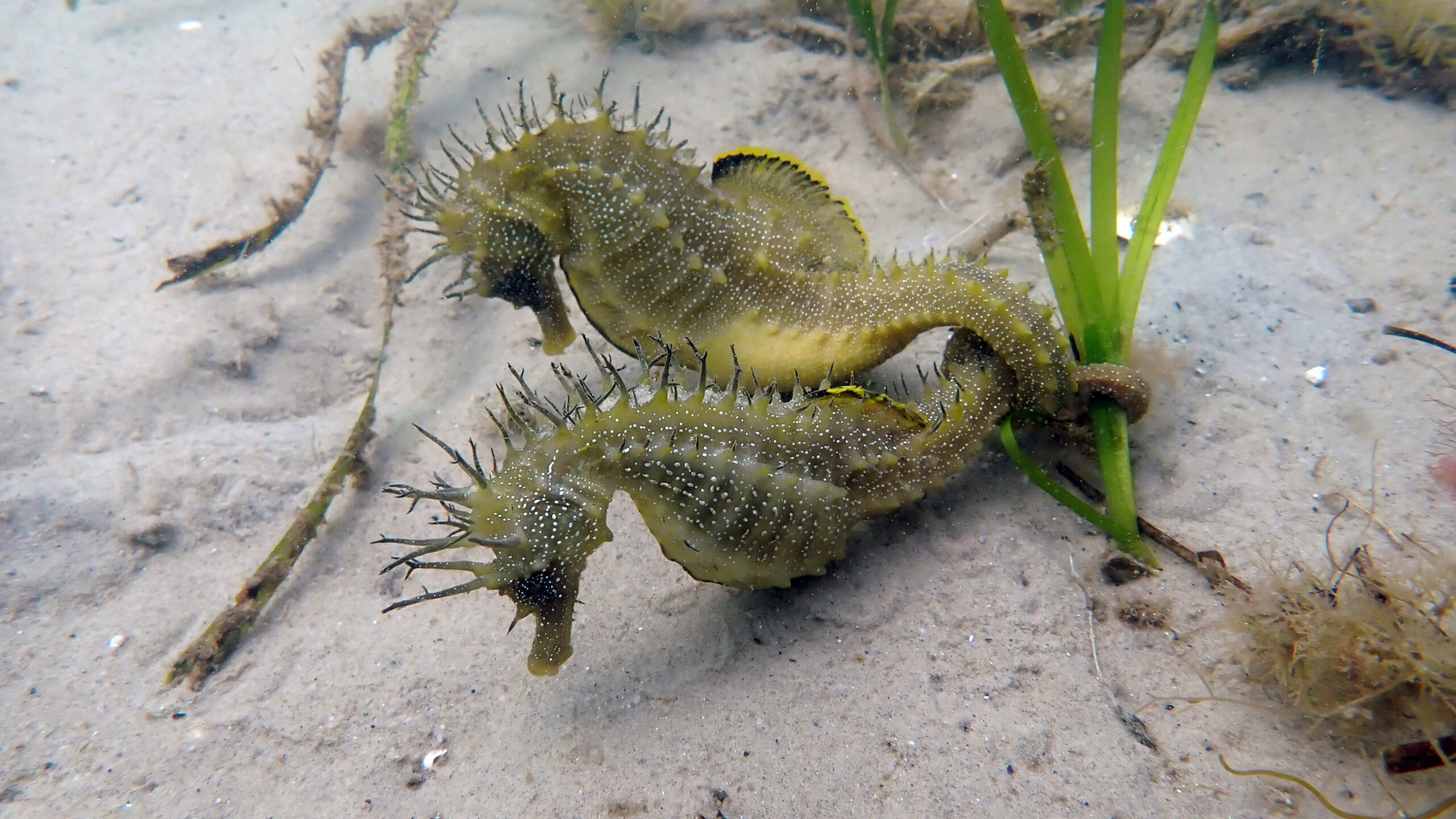
As seahorse numbers increase in Studland Bay, a growing community of divers is coming together to help monitor their progress.
At the UK Seahorse Symposium, held in Cardiff in November 2025, Dr Ken Collins, Emeritus Research Fellow at the University of Southampton, praised the volunteer divers who have spent years mapping Studland’s seagrass meadows and building a database of seahorse sightings. Some 40 divers now volunteer there each year.
Dr Collins said:
“The recovery of the seagrass meadows and increasing numbers of seahorses seem to be galvanising the diving community. Our volunteers, ranging from university students to retired divers, have put in nearly 3,000 hours between 2008 and 2025 – that’s equivalent to four months continuously underwater! If we were employing professional divers, it would cost around £750,000!
“Being invited to talk at the symposium shows that the work of the Studland Bay Marine Partnership to restore Studland’s seagrass meadows is being recognised as a leading UK example of marine conservation through co-operation. Our practices are being adopted around the world.”
The Studland Bay Marine Partnership, formed in 2021, brings together organisations and individuals committed to protecting and enhancing the seagrass beds, while still allowing people to enjoy the bay. Studland’s seagrass meadows are home to spiny seahorses, and the occasional short-snouted seahorse – both native species protected by UK law.
Neil Garrick-Maidment of The Seahorse Trust, has been monitoring seahorses at Studland since 2008. Along with Ken Collins, he campaigned for the protection of the seagrass meadows which led to Studland Bay being designated as a Marine Protection Zone (MPZ) in 2019, then later a Voluntary No-Anchor Zone. He said:
“The total population of seahorses in the MPZ is 45 to 50 individuals, but as the seagrass recovers, we hope to see more. There was a period when we didn’t see any seahorses, but now they appear on most dives – we even saw 22 on a single dive this year!
“None of this would have been possible without those amazing volunteers and the thousands of hours they have dedicated to the project, as well as the partnership approach through the Studland Bay Marine Partnership.”
One of the biggest threats to the seahorses has been traditional anchors which tear up the seagrass. Boaters are now encouraged to use eco-moorings which avoid damaging the seabed.
David Brown, lead ecologist at the National Trust and chair of the Studland Bay Marine Partnership, said:
“A few years ago, we mapped all the bare sand ‘scars’ in the seagrass beds caused by boat anchors. This year’s data shows that every one of them is healing, with new seagrass growing back. The impact has been beyond our expectations, and thanks to the monitoring, we have the science to prove how the eco-moorings benefit seagrass and all the species that rely on it.”